Home / Use Cases / Data Science
Walk in cold to the stats screen.
Read out the senior answer.
The gap between the rejection email and the Senior DS offer is five hours of live performance — not five years of work. Interview Clozo is an AI interview assistant for data science rounds: it hears the question and, about a second after it has it, displays exactly what to say — the right test, the assumptions, the SQL skeleton, the plain-English business framing — in a private cockpit only you can see. You just read it out loud. Every leap in knowledge looked unfair to the people who skipped it — memory, print, search — and this one joins you live, inside the stats screen.
Free trial included · “Better Loop” guarantee — 14 days on Monthly, 30 on Yearly · Mac app
 Your trial also brings Never Take the First Offer, our salary negotiation book: the exact words for the salary conversation →
The estimate, the query, the explanation. One window.
One session on the built-in Data Scientist role. Each question gets the format it needs — the number worked out, the query commented, the concept in plain English — and the first answer is still there at the end.
Watch three data-science questions in one session: a sample size worked out in the Math pane, SQL with a comment on every line, and bias–variance in plain English with the equation underneath.
What this demo shows (Interview Clozo on the built-in Data Scientist role, one session):
- The first question, “Estimate the sample size to detect a one-point retention lift.”, is already answered. The Short Answer says about 37,600 users per arm, roughly 75,000 in the test; the Math pane shows the two-proportion formula, defines every symbol, and works the numbers through to about 37,600.
- The interviewer asks “Write a SQL query: top three products per category.” The Short Answer gives the approach to say: total revenue per product, rank within each category with RANK so ties are kept, keep ranks one to three. Shift-Down steps through the answers to the Code pane: a SQL query with a comment on every line and its time and space complexity.
- The interviewer asks “Explain the bias-variance trade-off to a product manager.” The Short Answer explains it in plain English; the Math pane shows Error = Bias² + Variance + σ², with each term defined.
- Control-Shift-Left jumps back to the first question and its answers.
The Short Answer lands about a second after it has the question · up to 6 panes working on every question on Monthly, 10 on Yearly.
Your next data loop, with the math and the SQL on your screen.
Four ways strong data scientists fail loops.
You have done the work a hundred times. The interview asks you to redo it out loud, from memory, with a timer running — and one blank reads as shaky fundamentals in the debrief.
Case math under a spotlight
A lift calculation you have run a hundred times falls apart when a hiring manager watches you do it out loud.
Stats you know but cannot say
You understand p-values. Explaining one to a product manager in plain English, live, is a completely different skill.
The stakeholder curveball
“But how does this make money?” Your model was ready. Your business framing was not — and that is the answer they score.
SQL from memory, on a timer
Window functions you use daily vanish when the round is a shared doc and a countdown. One syntax slip reads as shaky fundamentals.
Every round in the data loop. Covered.
The cockpit adapts its panes to the round you are in — stats screen, SQL live-coding, or stakeholder case.
Statistics & Probability
The cockpit names the right test, lists its assumptions, and drafts the plain-English explanation — p-values, confidence intervals, and causal caveats included.
Machine Learning Design
Model choice, feature engineering, evaluation metrics, and the precision-recall trade-off — structured as panes you can narrate from requirements to monitoring.
SQL & Data Modeling
Query skeletons, window-function hints, and join-strategy rationale appear as soon as the interviewer finishes describing the schema.
Case Studies
Ambiguous metric cases get a structured decomposition: define the metric, segment the movement, rank hypotheses, recommend with numbers attached.
Data science loops land on the same venues as engineering loops, and each one has its own rhythm: CodeSignal timed assessments, HackerRank SQL and coding tests, CoderPad pair-programming sessions. The full list is on the platform coverage page. If the seat leans toward roadmap and prioritisation rather than modelling, the product management interview loop covers those rounds instead.
Before you buy an interview copilot, check the receipts.
“I stopped doing mock loops the week I installed it. The case round used to be my coin flip — Interview Clozo kept my metric decomposition structured while a director grilled me on every assumption. Signed with Airbnb at $152K.”
Every paid plan carries the Better Loop Guarantee — 14 days on Monthly, 30 on Yearly, under 200 generations used: noticeably sharper loops or every cent back. The risk is ours, not yours.
Senior DS is worth $30,000–$50,000 more a year.
The jump from Data Scientist to Senior is decided by how you perform in five hours of interviews — not five years of work. And the offer letter compounds for a decade.
Comp figures above are illustrative examples, not guarantees.
Data science questions.
Yes. As the interviewer describes the schema, the cockpit streams query skeletons, window-function hints, and join-strategy rationale. On paid plans, screenshot vision can also read the shared editor or doc as context, so the panes match the actual problem — not a generic one.
That is exactly what the Short Answer pane is for: it drafts the plain-English framing — p-values, confidence intervals, causal caveats — while the Technical Details pane keeps the rigorous version on screen. You narrate in your own voice with both in view.
Interview Clozo is a native Mac app that works with the desktop versions of Zoom, Teams, Meet, and Webex. It needs no virtual audio device — one-time setup, zero learning curve — and macOS window-level capture exclusion keeps the cockpit invisible to screen shares and recordings on supported setups, verified live in the app.
The trial runs on the plan you pick, with that plan’s limits — on Monthly, up to 6 panes working on every question and up to 20 per role, with screen reading and the stronger coding model; on Yearly, 10 and 40. Mixed rounds are where that pays off — the Short Answer lands first, and the stats framing, the SQL and the business narrative build right behind it.
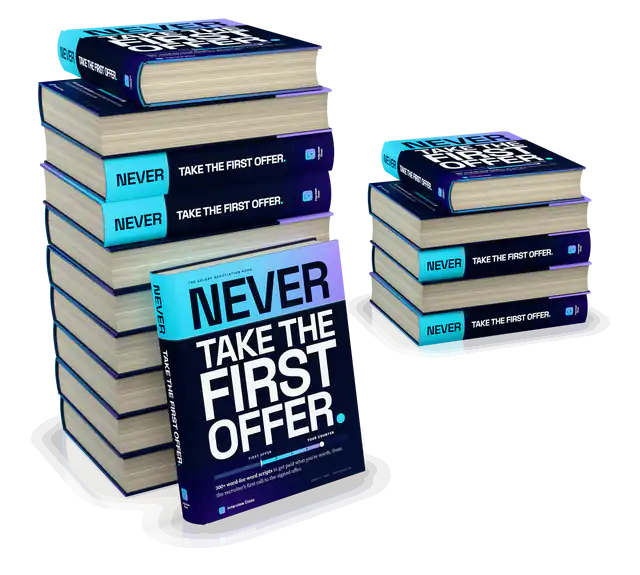
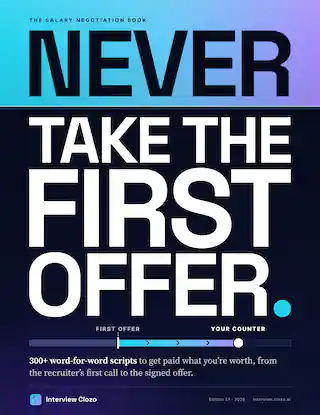
Free with your trial · The Salary Negotiation Book
The pay comes down to one conversation. Have the words ready.
Our salary negotiation book, Never Take the First Offer, gives you 370+ word-for-word scripts and 140+ pushback answers for every money conversation, from the recruiter’s first call to the signed offer — plus worksheets to plan your numbers before you say one.
Bonus: Never Take the First Offer, our salary negotiation book (PDF), emailed when you sign in on your Mac.
Before I name a number, could you share the range budgeted for this role? That way we both know quickly whether we’re aligned.— one of the scripts: “Ask for their range first”
2 steps to your free book: Start Free Trial, then sign in on your Mac.
Your next 3 interviews are on us. Every feature unlocked, within 14 days.
Your next data loop is on the calendar.
Walk in cold. Answer like you prepared for weeks.
Homo sapiens memorized definitions for weeks. Homo deus walks in cold — and the numbers are on your screen about a second after it has the question. Never blank on a metric definition again.
Start Free Trial · Money-back guarantee — 14 days on Monthly, 30 on Yearly · Mac app · The fairness case, both sides →